| Industry | Interactive entertainment |
|---|---|
| Fate | Acquired by Hilton |
| Founded | January 10, 1932; 88 years ago |
| Founder | Raymond Moloney |
| Defunct | December 18, 1996; 23 years ago |
| Headquarters | Chicago |
| Products | Pinball slot machines later expanded into casinos, video games, health clubs, and theme parks |
Bally Slot Machines: The Complete Service Manual for Series E 1980-1986 by Marshall Fey (1995-03-03) 4.7 out of 5 stars 4. I searched the web and located a guy that had developed a tester for testing the 6264 RAM chips. I sent him an email asking if this might be easily converted to test the 5101 RAM chip used in the Bally E Series slot machines and a large number of Bally Pinball machines.
Bally Manufacturing, later renamed Bally Entertainment, was an American company that began as a pinball and slot machine manufacturer, and later expanded into casinos, video games, health clubs, and theme parks. It was acquired by Hilton Hotels in 1996. Its brand name is still used by several businesses with some trademark rights, most notably Bally Technologies and Bally's Corporation.
History[edit]
The Bally Manufacturing Corporation was founded by Raymond Moloney on January 10, 1932, when Bally's original parent, Lion Manufacturing, established the company to make pinball games. The company took its name from its first game, Ballyhoo. The company, based in Chicago, quickly became a leading maker of the games. In the late 1930s, Moloney began making gambling equipment, and had great success developing and improving the mechanical slot machines that were the core of the nascent gaming industry. After manufacturing munitions and airplane parts during World War II, Bally Manufacturing Corporation continued to produce innovations in flipperless pinball machines, bingo machines, payout machines and console slot machines through the late 1950s. They also designed and manufactured vending machines and established a coffee vending service. The company made a brief venture into the music business with their own record label, Bally Records.[1]
Moloney died in 1958, and the company floundered briefly. With the financial failure of its parent company, Bally was bought out by a group of investors in 1963. Throughout the 1960s, Bally continued to dominate the slot machine industry, cornering over 90% of the worldwide market by the end of the decade. In 1964, Bally introduced the first electromechanical slot machine in 1963, called the 'Money Honey.', Bally became a publicly traded company and made several acquisitions, including German company Guenter Wulff-Apparatebau (renamed Bally Wulff) and Midway Manufacturing, an amusement game company from Schiller Park, Illinois.
The 1970s[edit]
In the late 1970s, Bally entered the casino business when New Jersey legalized gambling in Atlantic City. This effort moved forward even though the company was temporarily unable to attain a permanent license for the completed casino. During this period, company head William T. O'Donnell was forced to resign because of alleged links to organized crime. Prior to this, O'Donnell strenuously denied any such links.[2] For example, when questioned at the Moffitt Royal Commission (the NSW Clubs Royal Commission) - an investigation held New South Wales, Australia - on alleged criminal activities with US and Australian criminals, he admitted that Genovese Mafia boss, Jerry Catena (Gerardo Catena), once owned shares in the business, 'but I bought him out.'[2] He also denied knowing Chicago mobster, Joseph Dan Testa, even though Australian Police described Testa 'as a representative of Bally who visited Australia.'[2]
The company opened the Park Place Casino & Hotel on December 29, 1979.[3][4] Also in the late 1970s, Bally made an entry into the growing market for home computer games. The Bally Professional Arcade, as the machine was called, had advanced features for the time. These included a palette of 256 colors and the ability to play 4-voice music. The machine also shipped with a cartridge that allowed users to do a limited amount of programming on the machine themselves (using the BASIC language), and record their creations on cassette tape. The machine's price point was above the Atari 2600 (its major competitor), and it had a much more limited set of available games. Despite a loyal following, it failed to compete successfully. During the 1970s and early 1980s, Midway became a primary source of income for Bally as it became an early arcade video game maker and obtained the licenses for three of the most popular video games of all time: Space Invaders, Pac-Man and Ms. Pac-Man.[3]
The 1980s[edit]
By the mid-1980s, the company again had a strong balance sheet and began buying other businesses including the Six Flags amusement park chain in 1983, and the Health and Tennis Corporation of America. The health club division, under 'Bally Total Fitness', grew during the 1980s and 1990s. The company also purchased several casinos, including the MGM Grand Hotel and Casino on the Las Vegas Strip (which was subsequently re-branded as Bally's Las Vegas), The MGM Grand Reno (Reno, Nevada) and the Golden Nugget Atlantic City which was branded Bally's Grand and then later 'The Grand-A Bally's Casino Resort'. This expansion quickly took its toll on the company's finances, and Bally was soon forced to sell off several divisions, including Six Flags and Bally-Midway. The pinball division, along with Midway, was acquired by Williams Electronics in 1988.
The 1990s[edit]
In 1990, Bally came under new management as its largest shareholder, Arthur Goldberg, was appointed chairman and began a restructuring process.[5] By 1993, the company had sold off several divisions and used the proceeds to pay down debts, including the slot machine division (which became Bally Gaming International, an independent company); Scientific Games, a maker of lottery equipment; Bally's Reno; and exercise equipment maker Life Fitness.[6] The Aladdin's Castle chain of video arcades was sold that year to Namco, and was renamed as Namco Cybertainment.
The company opened Bally's Saloon & Gambling Hall, a riverboat casino in Mhoon Landing, Mississippi in December 1993.[7][8] It was moved to Robinsonville in 1995 and became part of a joint venture with Lady Luck Gaming.[9]
In 1994, the company changed its name to Bally Entertainment, to reflect its focus on the casino business and the fact that it no longer had any manufacturing operations.[10][11] It also announced that the health club business would be spun off to shareholders, to further narrow Bally's focus on casinos.[11] The spin-off was completed in January 1996, with Bally Total Fitness becoming a separate company.[12][13]

In May 1995, Bally Entertainment announced plans to develop Paris Las Vegas, a new casino hotel next to Bally's Las Vegas. The project would eventually begin construction in 1997 and open in 1999 at an estimated cost of $760 million.
In June 1996, Bally agreed to be acquired by Hilton Hotels Corporation.[14] The sale was completed on December 18, 1996, with Hilton paying $3 billion ($2 billion in stock plus $1 billion in assumed debt).[15] Later, Hilton's casino division, including the former Bally properties, was spun off as Park Place Entertainment (later Caesars Entertainment, Inc.), which was acquired in 2005 by Harrah's Entertainment (later Caesars Entertainment Corp.).
The name[edit]
Many casinos and businesses worldwide took on the Bally name and logo in the maze of ownership, division spin-offs and licensing agreements.
Midway, and—after buying Midway—Williams, continued to use the Bally name for its pinball games, until WMS Industries (the parent company of Williams) ceased pinball production in 1999. On March 31, 2005, WMS Industries struck a deal with Australian company The Pinball Factory to give them a license for the intellectual properties and the rights to re-manufacture former Bally/Williams games in the field of mechanical pinball. In addition, The Pinball Factory also has bought the right to manufacture new games using the company's new hardware system under the Bally brand.
Alliance Gaming, which had bought Bally Gaming International in 1995, changed its name to Bally Technologies. Bally Total Fitness, gambling distributor Bally France, and arcade distributor Bally Pond still use the same 'Bally' logo though any formal business relationships, as of June 2007, are coincidental. The rights to use the name for casinos were sold by Caesars in 2020 to Twin River Worldwide Holdings, which then changed its own name to Bally's Corporation and said that it would rename most of its properties under the Bally's brand.[16]
The name is was mentioned in the song, 'Pinball Wizard' in the rock operaTommy and its soundtrack.
Pinball machines using the Bally brand[edit]
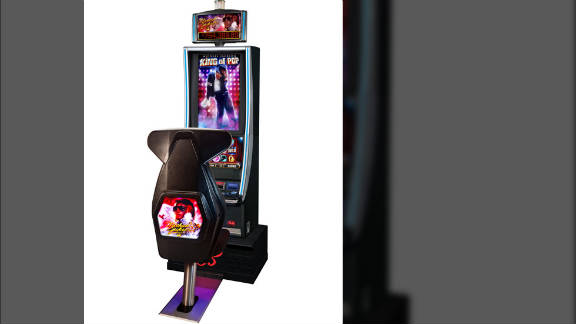
Select machines developed by Bally or Bally-Midway[edit]
- Amigo (1974)
- Ballyhoo (flipperless) (1932)
- Bally Baby (slot machine) (1932)
- Ballyhoo (flippers) (1947)
- Baby Pac-Man (1982)
- Blackwater 100 (1988)
- BMX (1982)
- Boomerang (1974)
- Bow and Arrow (1974)
- Capersville (1967)
- Captain Fantastic and The Brown Dirt Cowboy (1976)
- Centaur (1981) & Centaur II (1983)
- Cybernaut (1985)
- Dixieland (1968)
- Dogies (1968)
- Dungeons & Dragons (1987)
- Eight Ball (1977)
- Eight Ball Deluxe (1981)
- Embryon (1981)
- Evel Knievel (1977)
- Fathom (1981)
- Flash Gordon (1981)
- Fireball (1972)
- Fireball II (1981)
- Freedom (1976)
- Four Million B.C. (1971)
- Frontier (1980)
- Future Spa (1979)
- Gator (1969)
- Hi-Lo Ace (1973)
- Hokus Pokus (1975)
- KISS (1979)
- Lady Luck (1986)
- Lost World (1978)
- Mata Hari (1977)
- Monte Carlo (1973)
- Night Rider' (1977)
- Nip-It (1972)
- Nitro Ground Shaker (1978)
- Odds and Evens (1973)
- On Beam (1968)
- Mr. & Mrs. Pac-Man (1982)
- Paragon (1979)
- Playboy (1978)
- Power Play (1977)
- Shoot-A-Line (1962)
- Sky Divers (1964)
- Strange Science (1986)
- Strikes and Spares (1978)
- The Six Million Dollar Man (1978)
- Vector (1982)
- Wizard! (1975)
- Xenon (1980)
Developed by Midway[edit]
- The Addams Family (1992)
- Attack from Mars (1995)
- Black Rose (1992)
- Cactus Canyon (1998)
- The Champion Pub (1998)
- Cirqus Voltaire (1997)
- Corvette (1994)
- Creature from the Black Lagoon (1992)
- Doctor Who (1992)
- Dr. Dude and His Excellent Ray (1990)
- Eight Ball Champ (1985)
- Gilligans Island (1991)
- Harley-Davidson (1991)
- Indianapolis 500 (1995)
- Judge Dredd (1993)
- NBA Fastbreak (1997)
- The Party Zone (1991)
- Popeye Saves the Earth (1994)
- Radical! (1990)
- Revenge from Mars (1999)
- Safe Cracker (1996)
- Scared Stiff (1996)
- The Shadow (1994)
- Theatre of Magic (1995)
- Twilight Zone (1993)
- Who Dunnit (1995)
- World Cup Soccer (1994)
Developed by The Pinball Factory[edit]
The Crocodile Hunter Outback Adventure based on the wildlife documentary television series The Crocodile Hunter was in development by Australian pinball manufacturer The Pinball Factory under license from Bally. It was abandoned at the end of 2007 due to the death of the main character of the game, Steve Irwin, and never went into production.[17]
Slot machines[edit]
- Money Honey (1964)
- Big Top (1982)
- Jackpot Riot (1993)
- Blazing 7s (1993)
Casinos[edit]

References[edit]
- ^'Bally Records'.
- ^ abc'Bally chief denies links with mafia'. The Age. 18 September 1973. Retrieved 8 October 2018 – via Google News.
- ^ abChristian Marfels; 2007, Bally: The World's Game Maker, 2nd ed., Bally Technologies Inc., Las Vegas ISBN978-1-4243-3207-6
- ^'Bally Manufacturing Corp'. Encyclopedia of Chicago. Retrieved 21 June 2007.
- ^P.J. Bednarski (November 13, 1990). 'Top exec quits as Bally revamps'. Chicago Sun-Times – via NewsBank.
- ^Debra Dowling (December 19, 1993). 'Goldberg whips Bally Gaming into shape'. The Star-Ledger. Newark, NJ – via NewsBank.
- ^Laurel Campbell (December 7, 1993). 'Adjacent casinos open in Tunica'. The Commercial Appeal. Memphis, TN – via NewsBank.
- ^'Bally's licensed to open in Tunica'. The Commercial Appeal. Memphis, TN. AP. December 4, 1993 – via NewsBank.
- ^Michelle Hillier (December 22, 1995). 'Bally's rolls upriver, reopens casino closer to Memphis crowds'. Arkansas Democrat-Gazette. Little Rock, AR – via NewsBank.
- ^Scott Ritter (March 18, 1994). 'Options help CEO's earnings'. The Star-Ledger. Newark, NJ – via NewsBank.
- ^ abDavid Dishneau (May 18, 1994). 'Bally gambling its games will outperform its gyms'. Akron Beacon Journal. AP – via NewsBank.
- ^'Bally spin-off final'. Chicago Sun-Times. January 10, 1996 – via NewsBank.
- ^Debra Dowling (September 19, 1995). 'Bally Entertainment pushing out its network of push-up centers'. The Star-Ledger. Newark, NJ – via NewsBank.
- ^Barry Meier (June 7, 1996). 'Hilton Hotels to buy Bally Entertainment for more than $2 billion'. Los Angeles Times. Retrieved 2019-03-14.
- ^Joe Weinert (December 19, 1996). 'Hilton and Bally close deal'. The Press of Atlantic City – via NewsBank.
- ^'Twin River Worldwide Holdings to become Bally's Corporation'. Delaware Business Times. October 29, 2020. Retrieved 2020-11-11.
- ^'Internet Pinball Machine Database: The Pinball Factory 'The Crocodile Hunter Outback Adventure''. www.ipdb.org.
- Galecki, Irek (2006), Slot Machines History, Online Casino Press, archived from the original on September 17, 2012, retrieved 2007-06-25
- Wilson, Mark R. (2005), 'Bally Manufacturing Corp.', Encyclopedia of Chicago, Chicago, Illinois: Chicago Historical Society, retrieved 2007-06-27
- Lawlor, Pat (1992), 'The Addams Family', Pinball Hall of Fame, Internet Pinball Database, retrieved 2007-06-25
Repair Tips for Reel Readers
How to test and what to look for when doing your own repairs
When one of these goes bad you may see an error that would be 4x or 7x where x indicates thereel position, i.e. a 43 error code would indicate the reel reader on the third reel.
What is described below is for testing the reel reader card using this home built tester. The tester provides both a 50 volt source or a 5 volt source (switch selectable).
After describing this procedure I will tell you how to test the cards with out having to have a 50 volt source.
I designed and built a tester to make troubleshooting easier. I test the card and all of the photo-transistors
first, then I split the two halves of the card, one for cleaning but also so that I can use a dental tool, poking
it into the tiny opening to push the photo-transistor or IR Emitter back up and out of the small square opening. The photo-transistor/Emitter should be at something close to a 45 degree angle.
Once the bad components are pushed out of the way, I use my soldering iron to melt the solder on both leads at the same time while grasping the upper portion of the optic. It comes off very easily. Once removed use solder wick to remove the excess solder. You want to do this so that when you put in the new device the leads will be nearly flat on the PC board.
Replace the defective components and quickly tack one side, allow the solder to cool and then solder the other side. Once the other side has cooled you can go back and firmly solder the lead that was previously tacked. Reassemble and then retest to make sure that the optics are working properly. Tapping the top of the card lightly with the handle of a screw driver will show any intermittent connections.
The one question that may come up is what constitutes a bad device. Since the reader cards supply signals to TTL logic devices then we can use standard logic levels of 2.0 volts as a high and .8 volts as a low. When measuring the output of the photo transistor, if the voltage is less than 2.0 volts, while unblocked or higher than 0.8 volts when blocked then that photo-transistor (or emitter) is defective.
In the cards that I have repaired I typically see voltages of greater than 4 volts unblocked and .01 volts blocked for the 50 volt reader cards, 5 volt reader cards the unblocked voltage is 3.14 and the blocked voltage 0.2.
Test all of the emitters and photo-transistors first, the replace all defective ones. I make it a habit to clean the bulbs with alcohol on the 50 volt cards so that as much light as possible gets to the photo-transistor.
Testing reel readers without having a 50 volt source.
The 50 volt supply is only used to power the incandescent bulbs. They are in series along with the 470 ohm resistor. Each bulb requires 5 volts to operate properly.
You need a few basic items, a Volt/Ohm meter (DVM) , a 47K resistor, a light source (flashlight) and some clip leads and a 5 volt DC power supply
Split the cards by removing the 2 screws and lay the small card off to the side
If you lay the card flat on its back with the mounting bracket to the left then the pins at the bottom will number 1 through 16 from right to left
Measure the resistance between pin 16 and 14, Pin 16 is Vcc and 14 is Ground you should have a reading a bit above 500 ohms, indicating that the 470 ohm 2 W resistor and all of the bulbs are OK. If not in this range then you will have to remove the tape covering the backs of the bulbs and then measure resistance across each bulb individually. Remember the bulbs are wired in series like the old Christmas tree light strings.
Assuming that the bulbs and resistor are OK. Attach the ground lead of the volt meter and one end of the resistor to pin 14 (pairs 13/14)
of the card. Connect the other end of the resistor and the positive lead of the volt meter to pin 11.
Now using the 5 volt supply, apply 5 volts to pin 1 of the card and read the voltage, shine the light into the small (tiny) hole that is for Q1, voltage should be some where around 4.7 volts with the light on and some where less than 0.2 volts with the light off. Just keep in mind that ambient light might cause the light off reading to be higher. The acceptable voltage ranges need to be within the acceptable ranges used in ‘Logic” circuits so a logic high you need 2 volts or more and a logic low 0.8 volts or less.
You may find that if you have these readings, a Q-tip dipped into alcohol can be used to clean the top of the photo-transistor by pushing the Q-tip into the hole and then twisting the Q-tip. I routinely clean these as well as to clean the bulbs.
Repeat this process for each of the following pins 1, 3, 5, 7, 9
Other than pin 11, all of the other pins are in pairs
Pins 1 & 2 Collector of Q1
Pins 3 & 4 Collector of Q2
Pins 5 & 6 Collector of Q3
Pins 7 & 8 Collector of Q4
Pins 9 & 10 Collector of Q5
Pin 11, Common emitter
Pin 12 Missing (pin is cut off)
Pins 13 & 14 Ground
Pins 15 & 16 Vcc
This process is not nearly as quick or accurate as using the tester but should allow you to test each of the cards.
The 5 volt card testing process is not much different other than it is not necessary to split the cards and you need a 3K resistor instead of a 47K resistor.
Apply the 5 volts across pins 16 and 14 and then measure the voltage on the associated
pin pairs.
In this case the 3K resistor attached to pin 14 and pin 11 biases another transistor’s base (Q6), pulling it low so that it will turn on the IR Emitters. Remember to block the light for each IR emitter to see the photo-transistor transition to a low state.
Testing results for the 5 volt cards readers you will not read anywhere near 4.7 volts, they will be closer 3.0 volts for a high and about 0.2 volts for a low
Repair Tips for Power Supply
I have noticed that the schematic for the Bally E1000/E2000 power supplies list expected voltages, but, what does that mean?
I have a couple of these power supplies so I decided to do some testing to see what voltages were obtained under certain circumstances.
If you apply 12 VAC across pins 1 and 10 of the board J1 connector,you should be able to measure the voltages on the test points (+UR, ZC and 5V)
These voltage readings are based on a supply that has no load (nothing else connected)
UR = 15.96 VDC
ZC = 10.07 VDC
5v = 5.0 4VDC
One might think something is wrong because both UR and ZC are higher than the schematic states. However with no current we would expect to find the voltages higher, what matters is the voltage under load conditions.
The LM340-T5 Regulator has a maximum current output of 1 amp so using ohms law we know the voltage is 5 volts and the current is 1 Amp, Resistance can be calculated using the formula R=V/I (R=5/1) so R=5Ω, Now that we know what to use, we can figure out the wattage, this is rather simple, Watts = Amps x Volts so in this case we have 5 volts, 1 Amp so need 5 Watts. For testing I use a couple of 5Ω 5W resistors , actually, I use 20 Watt resistors to keep from burning my fingers. Anything smaller than 5W will burn and smoke is bad. The load resistors are placed across pins 13 and 20 of the J1 connector
To test the power supply drawing .5 amps we place 2, 5Ω resistors in series for a total of 10 Ω. With a 10 Ω load, drawing .5 amps these readings are fairly typical of what you should expect to see
UR = 12.16 VDC
ZC= 8.83 VDC
5v = 5.01 VDC
The final test is to test at full load, drawing 1 amp of current by removing one of the 5 ohm resistors so that only 5 ohms appears across pins 13 and 20 of J1, the readings you should expect to see would be.
UR = 7.57 VDC
ZC= 9.6 VDC
5v = 4.98 VDC
It would appear that the voltages shown on the schematic are voltages when the power
supply is measured with a full load.
I also recommend that when repairing these power supplies to remove the heat sinks from the bridge rectifier (BR1) and the 5 volt regulator (Q1). Clean off the old thermal heat sink compound and add new compound so that the heat transfer is more even. This will allow for maximum cooling.
The minimum voltage to expect from the LM340-T5 is 4.75 volts, if less than this then it is better to spend a couple of dollars and replace it.
Sometimes you will find that you have no voltage. In this case you want to check the 4 diodes and if the voltage seems to be half of what you expect then check the solder connections on the bottom side of the diodes. These will become bad because of heat. Other causes of no voltage is an open diode in the Bridge Rectifier (BR1).
I would recommend to anyone doing any type of repair work to invest in an ESR Meter. ESR means Equivalent Series Resistance and a high ESR can have adverse actions to your circuit. I have had several of these power supplies where despite changing the diodes, bridge rectifier and voltage regulator the output voltage was still below the regulators specified voltage of 4.75 volts @1 amp. These problems were resolved using my ESR meter and the discovery of the large 11,000 ufd capacitor having a high ESR value.
Can’t run Tests
I have seen many complaints of not being able to run the tests or clear errors on these E Series machines. If you have a light tower the WHITE light should be illuminated before the tests or resets can be done. This does not mean that a burnt out bulb will prevent this but only serves as a quick indication that you should be able to run tests or clear error codes. If you find that you are unable to run the tests or reset the machine, check the cherry switch behind the door hinges. If this switch goes bad it will signal the MPU board that the door is closed. Many owners of these E machines will bypass the door switch however the cherry switch must be operational
RAM Tester
Since many of the problems with the E Series slot machine are related to RAM failures I thought it would be a good idea to have one hanging around in my shop. I searched the web and located a guy that had developed a tester for testing the 6264 RAM chips. I sent him an email asking if this might be easily converted to test the 5101 RAM chip used in the Bally E Series slot machines and a large number of Bally Pinball machines. As it turned out he did not have a problem in making this modification as an ‘Engineering Change’ for me. My tester only tests the 5101 RAM chips, but NeoLoch Sales has since altered the design so that it will now test 5101, 6116, 21C14 and 9114 RAM Chips. It also will run on a 5, 12 volt power supplies or from a 9 volt battery.
Pachislo Slot Machine Reset Key
For further information please visit his website NeoLoc the page will open in a new window. This tester is now obsolete and has been replaced by a newer more versatile version
Reset Bally Game Maker Slot Machine
If you have some electronic design work that you need to get done contact David, he is easy to work with and offers reasonable prices.